
I used to be a Girl Scout Leader. What a wild ride. In that role, I helped shepherd a group of kids from early elementary school to high school. They grew and developed as individuals, and we learned to navigate cliques, bullies, varying interests, and growing up in general. You haven’t lived until you’ve convinced a group of tweens that they’re better off leaving their phones in a central location so they could be fully present.
We also made sure the kids had lots of opportunities to help in the community, so we worked with local nonprofit organizations on service projects. During one of those projects, one of my co-leaders commented, “Why are nonprofit organizations such a mess? They’re never organized.” I mean, she wasn’t wrong. Even the Girl Scout organization itself had its share of communication hiccups.
It doesn’t have to be that way. The nonprofit communication highway can flow freely with few roadblocks.
Nonprofit Communication Roadblocks
Bottlenecks
Remember Marge, the team member who has all the organizational knowledge stashed away in her head? When the answer to every question (procedures, logins, location of coffee filters, and more) is “Ask Marge,” you have a bottleneck. Now traffic slows to a crawl because all lanes lead to Marge. Everyone has to merge in order to reach her.
Now we’ve got a “Merge to Marge” problem.

Unclear Signage
I think we take signs for granted. We don’t know how much we rely on them until we don’t see the ones we need. If a tree branch covers a road sign, for example, how are we to know where to turn? Ever needed to use the bathroom in a strange place? You search for that “Restroom” sign like it’s the holy grail.
The same thing happens in your nonprofit communication. Unclear signs lead to wasted time. Some examples:
- Team members don’t know where to find files.
- Nobody knows who owns a task, so it doesn’t get done.
- Departments use different file names for the same thing.
- New volunteers or teammates don’t know where to go for help.
Having clear instructions and documentation in place will help your signage problem! The journey is so much easier with clear signs.
That leads me to…
Outdated Maps
Even the fanciest GPS system is only as good as the maps it can access. If a road closes or route changes and the maps don’t reflect that, you may as well be on your own with a compass and a canteen.
If your team has five versions of the same spreadsheet or has information stuck in Fred’s old email account 6 months after he leaves, you may as well be relying on old maps. Or maybe you have Standard Operating Procedures (SOPs) for various tasks, but they live all over the place and nobody knows which one to use.
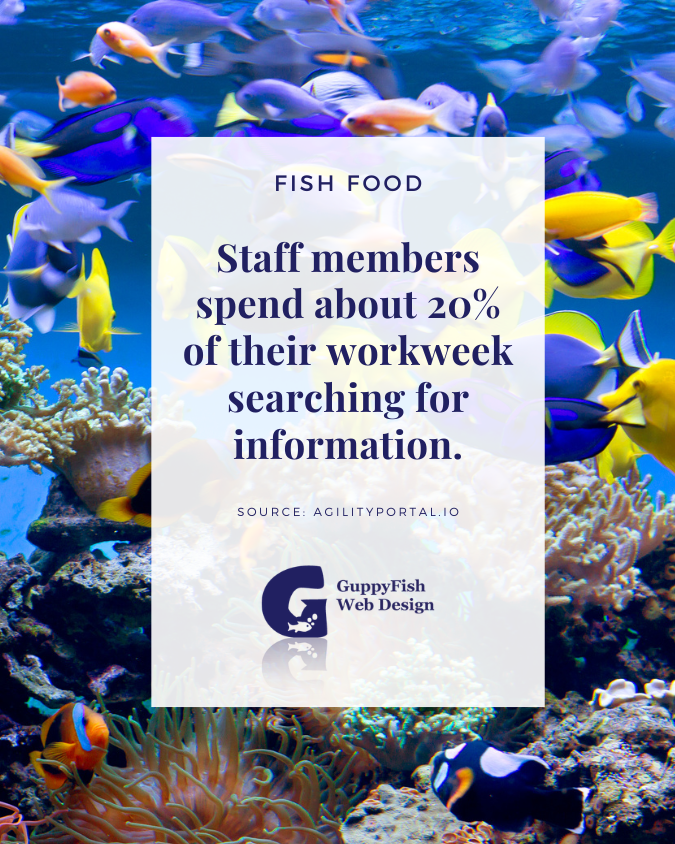
What difference does it make? Studies have shown that staff members use about 20% of their workweek just searching for information. That translates to one full day a week per person.
While working with a nonprofit client, I surveyed the staff and asked how much time they spent looking for files and dealing with disorganized systems. When we added it up and realized the impact, it really drove home how much time they were losing.
The Importance of a Smooth Nonprofit Communication Highway
In the corporate world, time equals money. Inefficiency affects the bottom line.
For a nonprofit organization, time equals help. Every hour spent dealing with unorganized systems is an hour that could be used to help someone.
“I’m going to go into nonprofit work so I can look for lost files and deal with disorganized systems,” said nobody ever.
No highway is perfectly smooth. That’s unrealistic. Little potholes will happen. If you have cleared away the preventable roadblocks, paving over that little pothole will go smoothly. Combine those potholes with a Merge to Marge problem, unclear signage, and maps from the last century, and your journey becomes less “fun road trip” and more “Are we there yet?”
You don’t have to fix everything at once. I have a free 5-Minute Systems Check that will help you identify where to start. Get it using the form below, and keep swimming along!


0 Comments